Why AI Feels Different When It Remembers You
Memory is part of the shift from one-off answers to ongoing continuity. That changes how AI systems work, how they feel, and what users need to control.

Memory has always been one of the simplest ways to make an interaction feel personal.
We know this outside of technology. A business where someone remembers your name feels different from one where every visit starts from zero. A bartender who knows your usual order, or a local shop where the greeting changes from “How can I help you?” to “Good to see you again,” changes the social temperature of the exchange.
Cheers built an entire theme song around that feeling: sometimes people want to go where everybody knows their name. Recognition is not the whole of belonging, but it is one of the quickest ways to create the feeling that an interaction has continuity.
Early chatbots found a crude version of the same effect. A bot that remembered your name, your username, or a few basic facts was not meaningfully intelligent in a human sense. It might have been doing little more than matching an account to a stored profile. Still, it felt different from a bot that simply replied as if every message came from a stranger. The memory did not have to be deep to matter. Even shallow continuity changed the experience.
Modern AI did not invent that feeling of recognition. It changed the scale of it.
Older bots could remember a name or map a username to a simple profile, but most of the interaction still felt narrow. You asked something, the bot replied, and the exchange usually stayed inside a small set of expected patterns. The memory made the bot feel a little more personal, but it did not usually create the sense that you were building a real conversation together.
Large language models changed that. For the first time, many people had software conversations that could actually develop. You could explain a project, introduce a distinction, correct a misunderstanding, establish a preference, and then keep going. The system could respond as if it was following the thread.
Once that happens, expectations change. If an AI can carry a conversation for ten or twenty minutes, it feels natural to expect it to remember the facts, decisions, and context established inside that conversation. When it forgets, the failure is not just technical. It feels socially strange. The system was with you a moment ago, and then suddenly it is asking you to reintroduce something you already made clear.
That is why context windows have been such a source of frustration. From the system’s side, the explanation may be ordinary: the conversation grew too long, the relevant detail fell out of view, or retrieval failed to bring back the right information. From the user’s side, it feels like broken continuity. The AI seemed to know what was going on, then lost the thread.
Memory, in this sense, is not just a convenience feature. It is a response to the expectations created by conversational AI. Conversation creates continuity. Continuity creates an expectation of recognition. Memory is one way these systems try to honor that expectation beyond the immediate exchange.
Part of the confusion is that memory is not one thing. A system can remember the current conversation, a saved preference, a project history, a source file, or a previous decision. Those layers feel different because they do different work. Conversation memory keeps the thread intact. Preference memory reduces repetition. Project memory creates momentum. File memory keeps the system grounded. Recall is what turns old context into something active again.
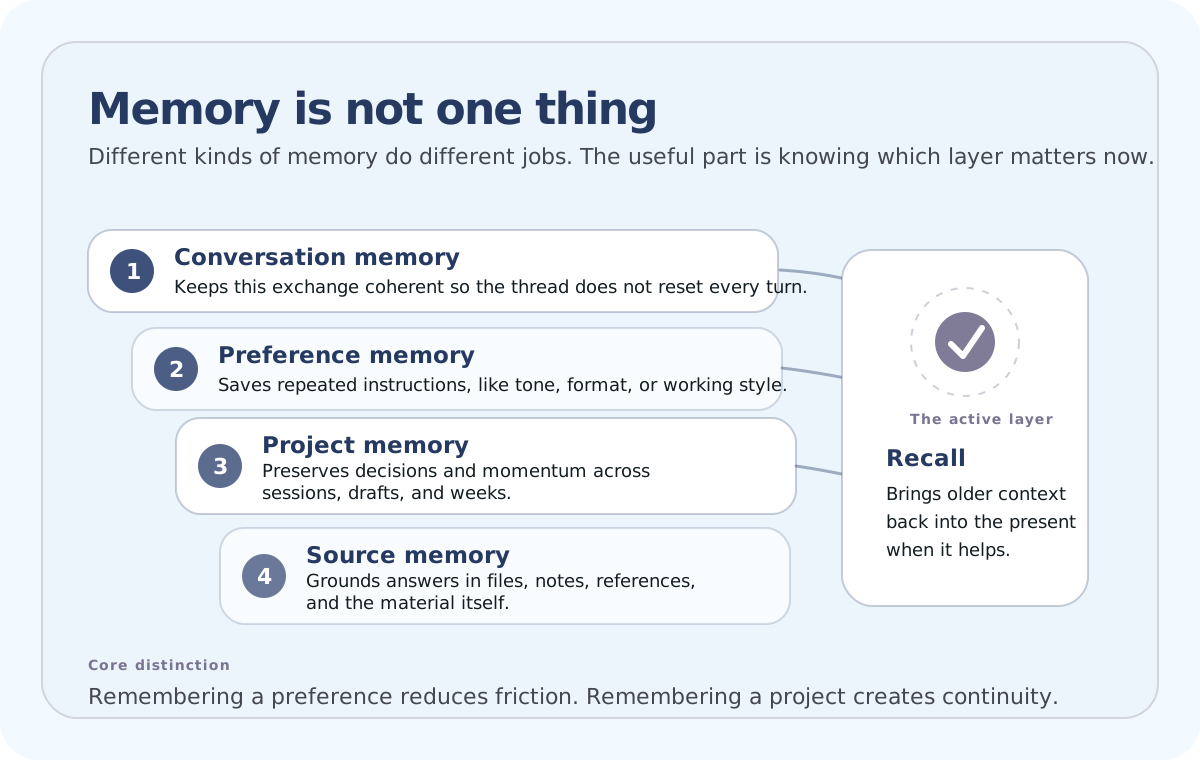
Remembering that you prefer short answers is different from remembering the details of a project you worked on last week. One saves friction. The other creates continuity.
That last part is what changes the feeling most. A stored fact sitting quietly in a profile is one thing. A system that can bring the past back into the present, at the moment it seems relevant, feels much more like an agent. It can notice that today’s question connects to a decision from last week. It can resume a project without making the user rebuild the room from scratch. It can make the interaction feel less like a series of disconnected prompts and more like ongoing work.
Tools like OpenClaw point toward a more flexible version of the idea. They do not treat memory as a single black-box feature. Beyond the bare minimum needed to keep a conversation coherent, they give the user more control over how memory is created, stored, reviewed, and revised.
That control matters because there is no universal best memory system. My own setup uses conversational history as raw material, then plays it back into a nightly process that updates more durable records. That rhythm works for me, but it is a design choice, not a law of nature.
In the time I have been using systems like this, I have seen multiple projects claim to have the best memory system. I understand the impulse. Everyone is trying to solve the same underlying problem: how to make these systems feel less like isolated transactions and more like something that can keep up with an ongoing human life.
Current memory systems still have flaws. ChatGPT’s web memory shows one version of the problem. When memory becomes too eager, the system can start treating stored facts as the default lens for everything. If it knows where you work, it may keep pulling unrelated questions back toward your employment. That can be useful when the topic really is work. It becomes distracting when the user is simply interested in something else.
But that limitation is also a sign of where the work is headed. The problem is no longer simply that these systems cannot remember. Increasingly, the problem is that they need better judgment about when memory matters. A remembered fact should be available when it helps, not forced into every exchange. Good memory should understand that a person has multiple roles, moods, projects, and curiosities.
That is why memory changes the feel of AI so much. The problem is not fully solved, but compared with starting from zero every time, the distance traveled is enormous. Memory gives the system continuity, and continuity is one of the things that makes interaction feel more natural. The goal is not an AI that remembers everything or an AI that remembers nothing. The goal is an AI that can recognize when the past matters, let it shape the present when useful, and stay out of the way when it does not.
When memory works, the system does not merely answer better. It feels different. It feels less like starting over, and more like returning to a conversation that was still there when you came back.

Ryan
Architect of digital systems and thoughtful experiments