You take a picture of a wilted houseplant and ask an AI assistant what is wrong.
It notices yellow leaves, suggests that the plant may be getting too much water, and recommends checking the soil. A moment later, you photograph a receipt and ask the same assistant to list the items and total. Then you point your camera at a loose cable behind the television and ask where it belongs.
These interactions can feel as if the AI is looking at the world the way you do.
It is not.
An image-capable AI can find patterns in a picture and connect them with patterns it learned from enormous collections of text and images. That can be remarkably useful. It can also produce a confident explanation while missing the tiny detail that matters most.
Understanding that difference helps you use photo-reading AI without giving it more trust than it has earned.
A Photo Becomes Data
To you, a photo may be a broken appliance, a family moment, or proof of what you bought.
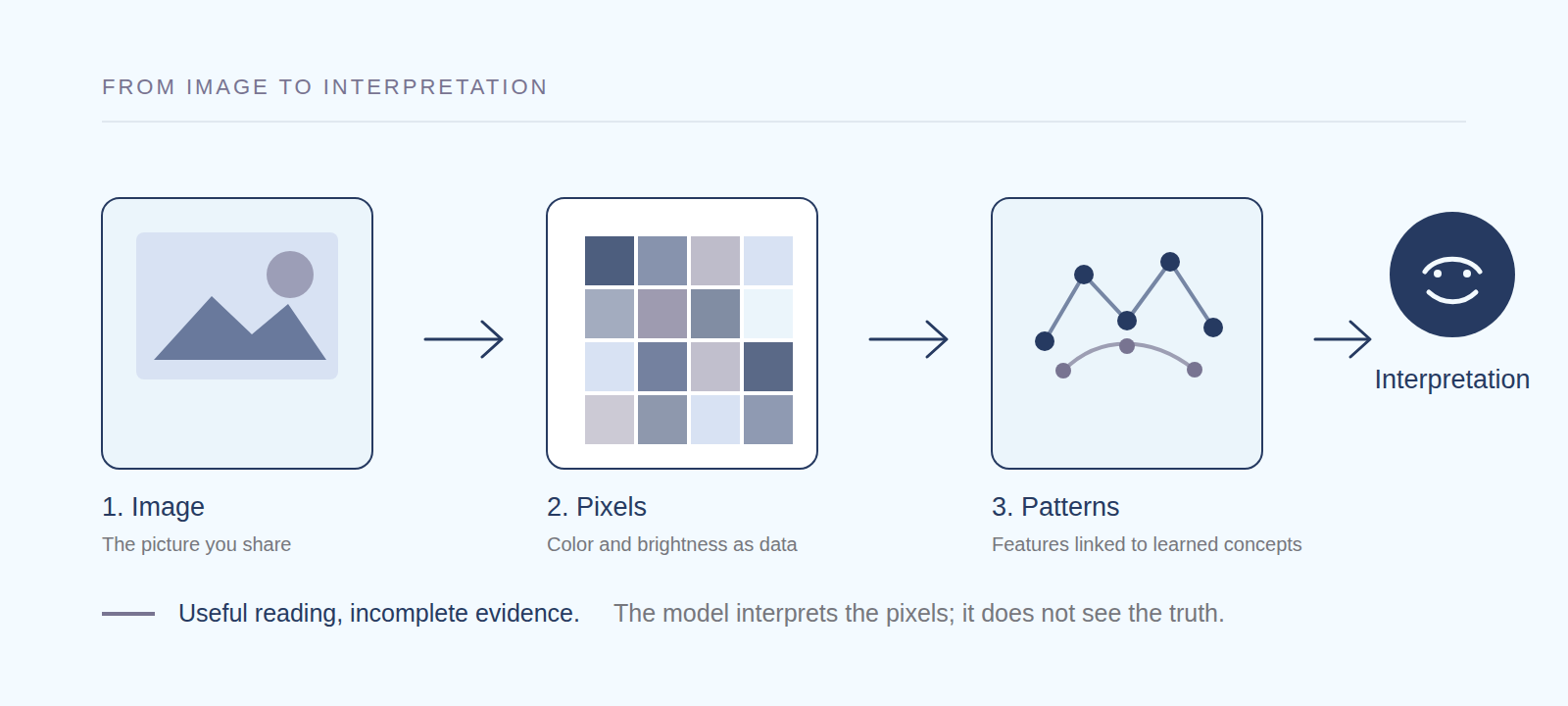
To a computer, it begins as a grid of pixels. Each pixel carries numerical information about color and brightness. Modern AI systems turn those numbers into smaller internal representations of visual features and relationships.
The system may detect edges, shapes, textures, printed words, and the way objects are arranged. It can connect those signals with concepts such as “leaf,” “invoice,” “warning light,” or “frayed cable.” If the system also understands language, it can use your question to decide which parts of the picture deserve attention.
Ask, “What kind of plant is this?” and it may focus on leaf shape and growth pattern. Ask, “Does this plant look healthy?” and it may pay more attention to spots, discoloration, and drooping stems.
The same picture can produce different answers because the question changes the job.
Recognition Is Not Understanding
When an AI labels an object correctly, it is tempting to assume that it understands the whole scene.
Usually, it understands less than the answer suggests.
It may recognize a smoke detector but not know whether the small light in your particular model means normal operation or a fault. It may read most of a receipt while confusing a discount with a charge. It may identify a rash as resembling a familiar condition while lacking the medical history, lighting accuracy, and physical examination needed for a diagnosis.
The system is making an interpretation from visible evidence. It does not automatically know what happened before the photo, what sits outside the frame, whether colors are accurate, or which details your camera blurred.
That is similar to the broader problem described in What “Grounded” AI Actually Means: an answer can sound complete even when the available evidence is incomplete.
Small Details Create Large Mistakes
Photo-reading AI tends to work best when the important thing is large, clear, well lit, and common.
Current provider guidance on vision limitations calls out small text, rotated images, precise spatial tasks, counting, and occasional incorrect descriptions. Those are useful warnings even when you use a different image-capable assistant.
Performance becomes less reliable when:
- text is tiny, curved, handwritten, or partly hidden;
- several similar objects are crowded together;
- lighting changes the apparent color;
- the useful clue is a small crack, code, label, or connector;
- the image lacks scale or surrounding context;
- the object is unusual or highly specialized.
A person can fail for the same reasons. The important difference is that an AI may fill a gap with a plausible guess instead of clearly saying that it cannot see enough—the same pattern behind why AI makes things up.
If the answer depends on a serial number, dosage, price, wiring position, or other exact detail, zoom in and verify it yourself. Better yet, provide a close-up and a wider photo so the system has both detail and context.
The Question Matters as Much as the Picture
“What is this?” invites a broad label. “Read the model number exactly, and say when any character is unclear” asks for a more careful task.
Useful requests tell the AI what kind of result you need and where uncertainty matters.
For a receipt, you might ask it to extract the merchant, date, line items, tax, and total into a table, then flag any number it cannot read confidently. For a damaged appliance, ask it to describe only what is visible before suggesting possible causes. For a plant, share more than one angle and describe how often you water it.
You are not teaching the AI to see. You are narrowing the job and making missing evidence easier to notice.
Remember That Uploading Is Sharing
A photo can reveal more than its subject.
A picture of a document may include an address, account number, signature, or barcode. A family photo may reveal faces, children, the inside of a home, or a location. A screenshot can expose names, private messages, browser tabs, and notification previews.
Before uploading an image, inspect the whole frame. Crop or cover details the task does not require. Avoid sharing sensitive medical, financial, workplace, or identity documents unless you understand and accept how the service handles uploaded data.
The convenience of asking a question does not make the picture less private.
A Practical Trust Test
Before acting on an answer about a photo, ask three questions:
- Can I see the evidence myself? If the AI says a wire is damaged or a total is $42.18, locate that detail in the image.
- What would happen if the answer were wrong? A mistaken plant suggestion is different from mistaken medical, electrical, or safety advice.
- Can another source confirm it? Check the product manual, original document, qualified professional, or another clear photo.
The higher the cost of a mistake, the less a single image-based answer should decide.
Use It as a Second Set of Eyes
Photo-reading AI is often excellent at giving you a starting point.
It can turn a printed page into editable text, describe an unfamiliar object, organize information from a whiteboard, suggest what to inspect on a broken device, or help someone understand a visual scene. Those are meaningful capabilities.
The safest mental model is not “the AI saw the truth.”
It is “the AI offered an interpretation of the pixels I shared.”
That interpretation can save time and reveal things you missed. Keep the original image, your own judgment, and the consequences of a mistake in the loop.